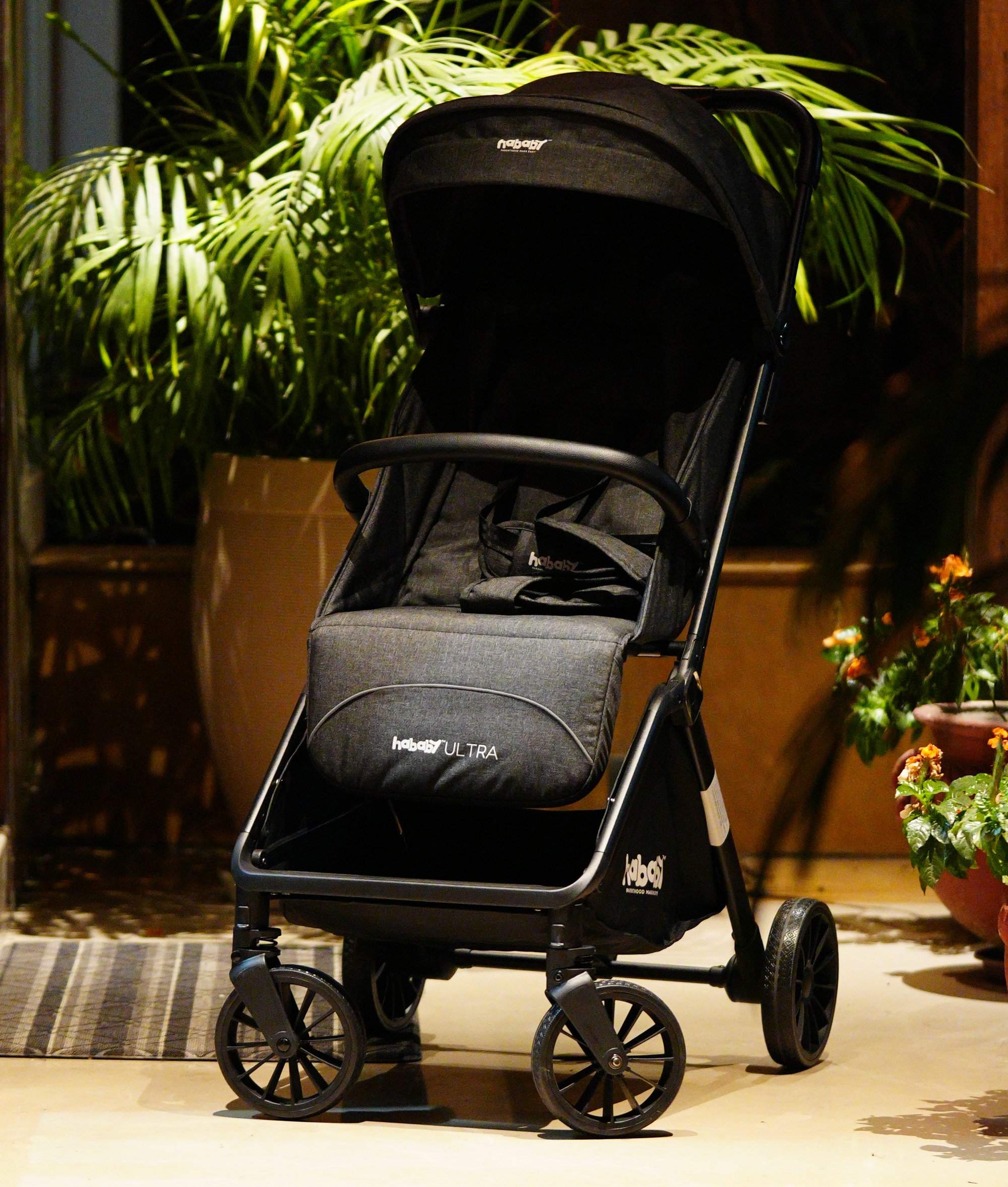
Putting your newborn into a stroller for the first time is one of the most nerve-wracking moments of early parenthood. The product looks designed for older babies, the harness is bigger than the baby, and Indian summer heat makes you wonder if it's even safe to take them outside. This guide answers, with no marketing fluff, what actually keeps a newborn safe in a stroller in India: the recline angle, the harness, the certification, the heat, and the mistakes that even careful parents make.
A newborn can use a stroller from day one only if it has true flat recline (175–180°), a 5-point harness, and EN1888 safety certification. The Hababy Ultra meets all three. Avoid semi-recline pushchairs and uncertified umbrella buggies until your baby can sit up unsupported (around six months).
When Can a Newborn Use a Stroller?
From day one — but only in a stroller that lies completely flat. The clinical reason: until about six months, a baby's neck muscles cannot reliably hold the head upright, and a baby in a semi-upright position can slump so the chin presses to the chest. This compresses the airway. Paediatricians and the international stroller safety standard (EN1888) both require flat positioning for newborns.
The practical rule:
- 0–6 months: Flat recline only (175–180°), or carrycot/bassinet attachment.
- 6–9 months: Semi-recline allowed once the baby can sit unsupported.
- 9 months+: Upright seat is fine for full-day use.
The Flat-Recline Rule (and Why It's Non-Negotiable)
If you remember one thing from this guide: "semi-recline" is not flat. Many strollers labelled "from birth" only recline to 150°. That's not enough for a newborn. The angle that matters is 175–180°, where the baby's spine is fully horizontal.
How to test in store or at unboxing:
- Recline the seat all the way back.
- Place a long ruler or your forearm flat along the seat surface.
- If the head end is more than 5° higher than the foot end, it is not newborn-safe.
Once the baby is in, the chin should never be touching or near the chest. If it is, the recline is insufficient or the harness is too loose. Take the baby out and adjust before walking.
5-Point Harness Use for Newborns
A 5-point harness has straps over both shoulders, both hips, and one between the legs — meeting at a single buckle on the chest. It's the international safety standard. Three-point harnesses don't stop a newborn from sliding forward and down.
Newborn-specific harness rules:
- Use it every time — even on a 5-minute walk in the building corridor.
- Snug, not tight. You should be able to slip two fingers flat between the strap and the baby's chest.
- Shoulder straps should sit at or just below the shoulder, never above.
- The crotch strap stops the baby from sliding down. Never skip it.
- Use a newborn insert for the first 8–12 weeks — it stops the harness from slipping off tiny shoulders.
EN1888 and Indian Stroller Safety Standards
India does not yet mandate a stroller-specific BIS standard. The two recognized international standards are:
| Standard | Region | Covers |
|---|---|---|
| EN1888 | Europe (incl. UK) | Stability, brakes, harness strength, frame, finger-pinch points |
| ASTM F833 | USA | Stability, harness, hazard testing, recall protocol |
| BIS | India | No stroller-specific standard yet |
Look for EN1888 on the box, in the manual, or in the spec sheet. If it's not there, assume the stroller hasn't been independently safety-tested.
The Hababy Ultra carries EN1888 certification — the same standard used by premium European brands like Bugaboo and UPPAbaby.
Indian Summer Heat and Stroller Use
Newborns regulate their body temperature poorly. In an Indian summer, a stroller can become a heat trap within minutes. The rules:
1. Avoid 10 AM–5 PM in summer
Walks should happen early morning or evening. Direct midday sun is the highest risk for heat stress.
2. Never drape a thick cloth over the canopy
This is the most common Indian mistake. A muslin or dupatta over the open canopy traps heat and reduces airflow — the temperature inside can climb 10°C above ambient. Use the stroller's UPF-rated extending canopy instead.
3. Touch-test the seat surface
Before placing the baby in, press your palm flat on the seat for 5 seconds. If it's uncomfortable to your hand, it's unsafe for the baby.
4. Hydrate the baby on long outings
For breastfed babies under 6 months: feed more often. For formula-fed babies: small sips of cooled boiled water every 30–45 minutes in heat.
5. Use a clip-on stroller fan
USB-powered, on the canopy frame — circulates air without blowing directly onto the baby's face.
7 Common Newborn-Stroller Mistakes Indian Parents Make
- Using a semi-recline stroller for a newborn. The most common mistake. Wait for true 175°+ recline or use a carrycot.
- Skipping the harness for "just a quick walk". Most stroller injuries happen on short trips.
- Draping a cloth over the canopy. Traps heat dangerously in Indian summers.
- Long stroller sessions over 90 minutes. Take the baby out for a position change and bonding.
- Hanging shopping bags on the handle. Tips the stroller backward when the baby's weight isn't there. Use the underseat basket only.
- Buying a 3-wheel jogger as the first stroller. Joggers are designed for older babies and paved tracks — not Indian footpaths or newborns.
- Ignoring the brake. Always engage when stationary, even on level ground — especially on inclines, train platforms, and apartment lift lobbies.
Hababy Ultra Newborn Safety Features
The Hababy Ultra was designed specifically against newborn safety standards for the Indian market:
- 175° flat recline — newborn-safe from day one, no carrycot purchase required.
- 5-point safety harness with newborn shoulder pads.
- EN1888 European certification — tested for stability, brake strength, harness strength, and finger-pinch points.
- UPF 50+ extending canopy — no need for additional cloth covers.
- Ventilation window in the canopy with mesh insert for airflow checks.
- Auto-engaging rear brake — one tap with your foot, locks both rear wheels.
- Soft-suspension wheels — absorbs Indian footpath bumps that otherwise transmit to a newborn's spine.
₹7,999 across India. Free shipping, COD available, 7-day return policy. See full specs →
Frequently Asked Questions
When can a newborn use a stroller?
From birth, but only in a stroller that reclines fully flat (175–180°) or has an attached carrycot. Until at least six months, a newborn must lie flat to keep their airway open.
What is the safest stroller position for a newborn?
Fully flat (175–180°), face-up, with the head supported by the headrest or a soft newborn insert. The 5-point harness should be snug. Never the chin-to-chest position caused by semi-recline.
Is a 5-point harness necessary for a newborn stroller?
Yes. A 5-point harness (two shoulder, two waist, one between legs) is the international safety standard. Three-point harnesses don't stop a baby from sliding forward and out.
What stroller safety standard should I look for in India?
EN1888 (European) or ASTM F833 (American). India does not yet mandate a stroller-specific BIS standard, so EN1888 is the gold standard. The Hababy Ultra carries EN1888 certification.
Can a newborn stay in a stroller for too long?
Paediatricians recommend not keeping a newborn in a stroller for more than 90 minutes at a stretch without taking them out for a position change, feeding, or close-contact time.
Is it safe to use a stroller in Indian summer heat?
Use it before 10 AM or after 5 PM, never in direct midday sun. Don't drape a thick cloth over the canopy — it traps heat. Use a UPF-rated extending canopy and a clip-on fan, and check the seat temperature with your hand before placing the baby.
When can a baby switch from flat-recline to upright stroller mode?
Around six months, when the baby can hold their head up steadily and sit unassisted. Before that, even a partially upright position can compromise the airway.