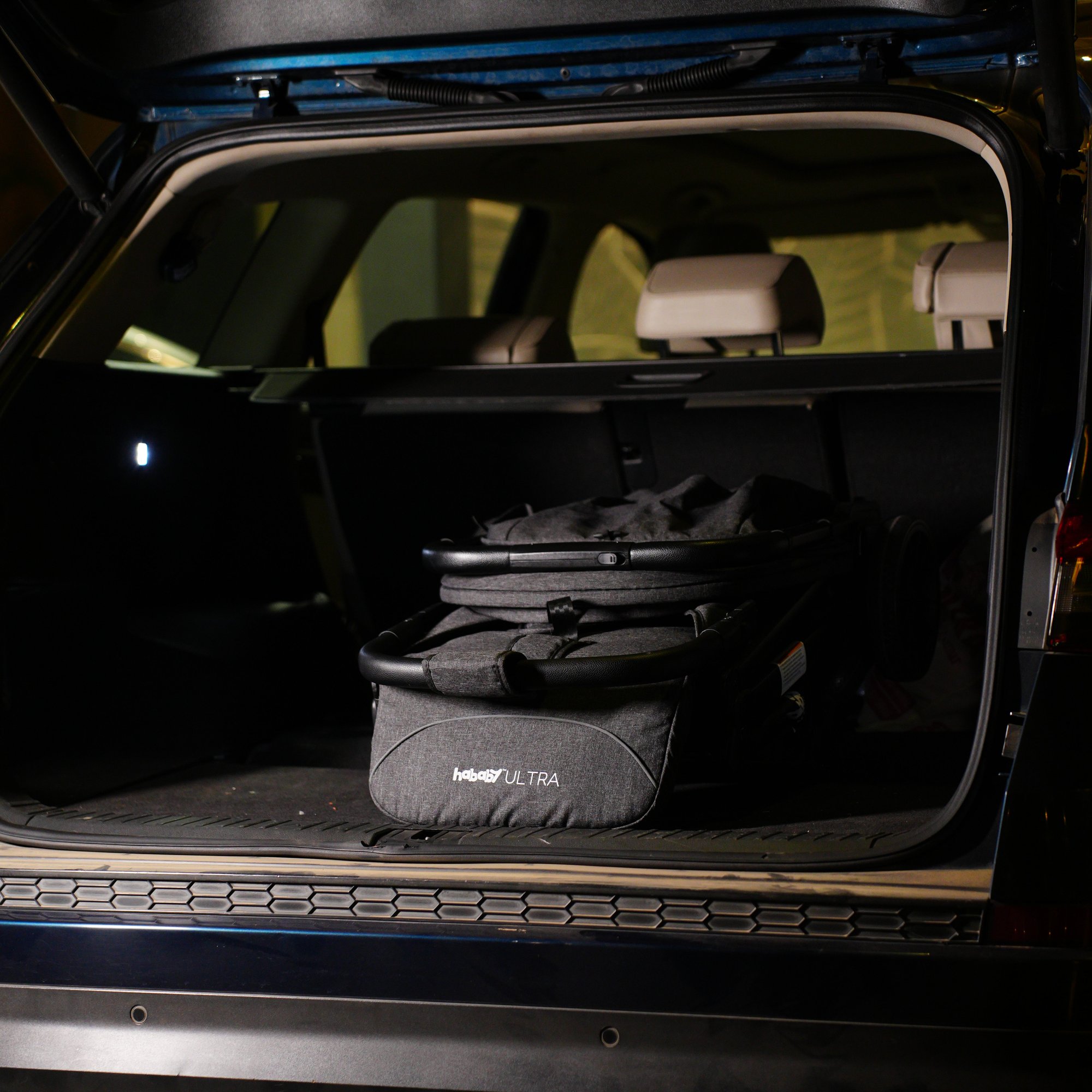
"Lightweight" is the most overused word in Indian stroller marketing. Brands slap it on 9 kg strollers, on uncertified umbrella buggies, on anything with thin wheels. So what does lightweight actually mean in 2026, and what should you check before paying for one? This guide gives you honest weight numbers, a clear definition, and the buying checklist Indian parents need — especially if you fly often, take autorickshaws, live in a walk-up, or just don't want to lift 10 kg of metal up four flights of stairs every evening.
A genuinely lightweight stroller in India weighs 5.5–7.5 kg with canopy and basket included, folds one-handed, and fits in an autorickshaw boot. The Hababy Ultra is 7.2 kg, has true flat recline for newborns, and is EN1888 European safety certified — rare at this price point.
What "Lightweight" Actually Means in 2026
There's no Indian regulator that polices the word "lightweight" on stroller listings. Brands use it freely. To make sense of the category, it helps to draw a line at 7.5 kg with the canopy and basket fitted. Below that line, you can comfortably lift the folded stroller one-handed up a flight of stairs, into an autorickshaw boot, or into a flight cabin. Above that line, you really need both hands and you'll feel it on the third floor.
The trick brands play: they quote the weight of the bare frame with no canopy, no basket, no rain cover. That's the "marketing weight". The number that matters is the real-use weight — what you actually carry when you fold the stroller after a walk.
Honest Weight Categories for Indian Strollers
| Category | Real Weight | Use Case | Trade-off |
|---|---|---|---|
| Ultra-light umbrella buggy | 3.5–5 kg | Older babies on short outings | Often no flat recline; not newborn-safe |
| True lightweight stroller | 5.5–7.5 kg | Birth to 3 yrs, daily Indian use | Best balance for most parents |
| Compact full-feature stroller | 7.5–9 kg | City + light travel | Heavy for stairs and air travel |
| Travel system | 10–13 kg | Car-first families | Too heavy for autos and walk-ups |
The Hababy Ultra sits in the middle "true lightweight" band at 7.2 kg with canopy and basket — light enough for Indian travel, heavy enough to include EN1888-grade safety, all-wheel suspension and a real flat-recline mode for newborns.
Why Lightweight Matters Specifically in India
In Western catalogues, "lightweight" is a nice-to-have. In India, the daily reality of using a stroller punishes every extra kilogram:
1. Autorickshaws and Olas
You'll often need to lift the folded stroller into an autorickshaw boot or a small Ola hatchback. Above 8 kg, you'll regret it within a week.
2. Walk-ups and lift outages
Indian apartment lifts go down. Often. Carrying a 9 kg stroller plus a baby up four floors is a job; carrying a 7 kg one is doable.
3. Air travel within India
Domestic flights are a regular part of Indian family life. IndiGo, Air India and Vistara have weight thresholds for cabin strollers (more on that below) — lightweight strollers fly with you, heavy ones get gate-checked.
4. Train travel
Indian Railways has narrow corridors and tall steps. A folded stroller you can hold in one hand while climbing aboard is the difference between a smooth journey and a stressful one.
5. Footpath quality
A lighter stroller with proper suspension handles broken footpaths better than a heavy one without — weight isn't the only factor, but it compounds the strain on the wheels and frame.
Cabin-Size Rules: IndiGo, Air India, Vistara, Akasa
Domestic Indian airline rules around strollers change periodically. As of April 2026, the general pattern is:
- IndiGo: One stroller per child travels free. Strollers above 7 kg or that don't fold to a compact size are gate-checked at the aircraft door and returned at the destination gate.
- Air India: Similar — cabin acceptance for compact, foldable, lightweight strollers; gate-check otherwise.
- Vistara: Compact strollers can be carried as cabin baggage; larger strollers checked in at the counter.
- Akasa Air: Strollers free for infants; cabin acceptance limited to compact, lightweight models.
Airlines publish slightly different stroller rules on different parts of their websites. Call customer care 24 hours before your flight and confirm the weight + folded-size limit for your specific aircraft and route. Save the email or screenshot.
7-Point Lightweight Stroller Buying Checklist
- Real weight under 7.5 kg (with canopy + basket fitted). Ignore "frame-only" weight claims.
- True flat recline (175–180°) if you'll use it for a newborn. Otherwise it's only good after six months.
- One-handed fold. You will be holding the baby in the other hand. Always.
- Folded size under 80 cm in the longest dimension. Any larger and it won't fit standard auto boots.
- EN1888 or equivalent safety certification. Lightweight should not mean unsafe.
- Real wheel suspension. Indian footpaths demand it. Hard plastic wheels with no suspension will rattle the baby and crack within months.
- Indian after-sales support. WhatsApp, COD, returns. A ₹6,000 imported stroller with no service is worse than a ₹7,000 Indian-supported one.
Hababy Ultra — Lightweight Done Right for India
The Hababy Ultra was engineered specifically against this checklist:
- 7.2 kg real weight with canopy, basket, rain cover and NavBaby GPS module installed.
- 175° flat recline — newborn-safe from day one.
- One-handed fold in 1.5 seconds; auto-lock in folded position.
- Folded size: 24 × 46 × 76 cm — fits autorickshaw boots, Indigo aircraft holds, and Mumbai local lifts.
- EN1888 European safety certified — the same standard used by Bugaboo and UPPAbaby.
- All-wheel suspension with rear wheels rated for Indian uneven surfaces.
- NavBaby GPS built in — locate it on Apple Find My or Google Find Hub.
- India-based service: WhatsApp support, COD, free shipping, 7-day returns.
₹7,999 across India. Free shipping, COD available, 7-day return policy. See full specs →
Common Mistakes When Buying a Lightweight Stroller
1. Buying on weight alone
A 4 kg umbrella buggy without flat recline is unusable for the first six months. You'll end up buying a second product. Net cost is higher than buying one good lightweight stroller upfront.
2. Trusting marketing weight
If a product says "5.5 kg" but the listing photo shows it without canopy or basket, the real-use weight is likely 7 kg or more. Always check the spec sheet for "with accessories" weight.
3. Ignoring suspension
Lightweight strollers without suspension transmit every footpath bump to the baby. Ride quality matters as much as weight.
4. No certification
Many low-cost lightweight strollers on Indian marketplaces have no safety certification at all. Always look for EN1888 (European) or equivalent.
5. Ignoring after-sales
A great-spec imported stroller is useless if a wheel needs replacing in month 14 and the brand doesn't ship spares to India.
Frequently Asked Questions
What counts as a lightweight baby stroller in India?
In 2026, a lightweight stroller in India typically weighs 5.5–7.5 kg with the canopy and basket included. Under 5 kg is usually a thin umbrella buggy without recline; over 8 kg is a full-feature stroller marketed as "compact" rather than truly lightweight.
How heavy is the Hababy Ultra?
The Hababy Ultra weighs about 7.2 kg with canopy and basket — at the lightweight end of full-feature strollers that include true flat recline, EN1888 certification, all-wheel suspension and built-in NavBaby GPS.
Are lightweight strollers cabin-size for IndiGo, Air India and Vistara?
IndiGo, Air India and Vistara generally allow strollers under 7 kg as cabin baggage if they fold to under 115 cm (length + width + height). Heavier strollers must be gate-checked. Always reconfirm the airline's current rule before flying.
Do lightweight strollers work for newborns?
Only if the stroller has true flat recline (175–180°). Many cheap lightweight buggies recline only partially and are unsafe for babies under six months. Look for an explicitly newborn-rated lightweight stroller like the Hababy Ultra.
What is the best lightweight stroller for autos and Indian roads?
Look for one-handed fold, a folded size under 80 cm in the longest dimension, and rear suspension. The Hababy Ultra folds to roughly 24 × 46 × 76 cm, fits an autorickshaw boot, and has all-wheel suspension for uneven footpaths.
Are lightweight strollers less safe than heavy ones?
Not necessarily. Safety depends on certification, not weight. EN1888-certified lightweight strollers meet the same European safety standard as heavier ones. Avoid uncertified ultra-light buggies that skip on harness, brake, and frame strength.
How much does a good lightweight stroller cost in India?
Decent EN1888-certified lightweight strollers start at around ₹6,000 in India in 2026, with full-feature options like the Hababy Ultra at ₹7,999. Branded imports (Bugaboo, UPPAbaby, Joie) cost ₹25,000–₹70,000.