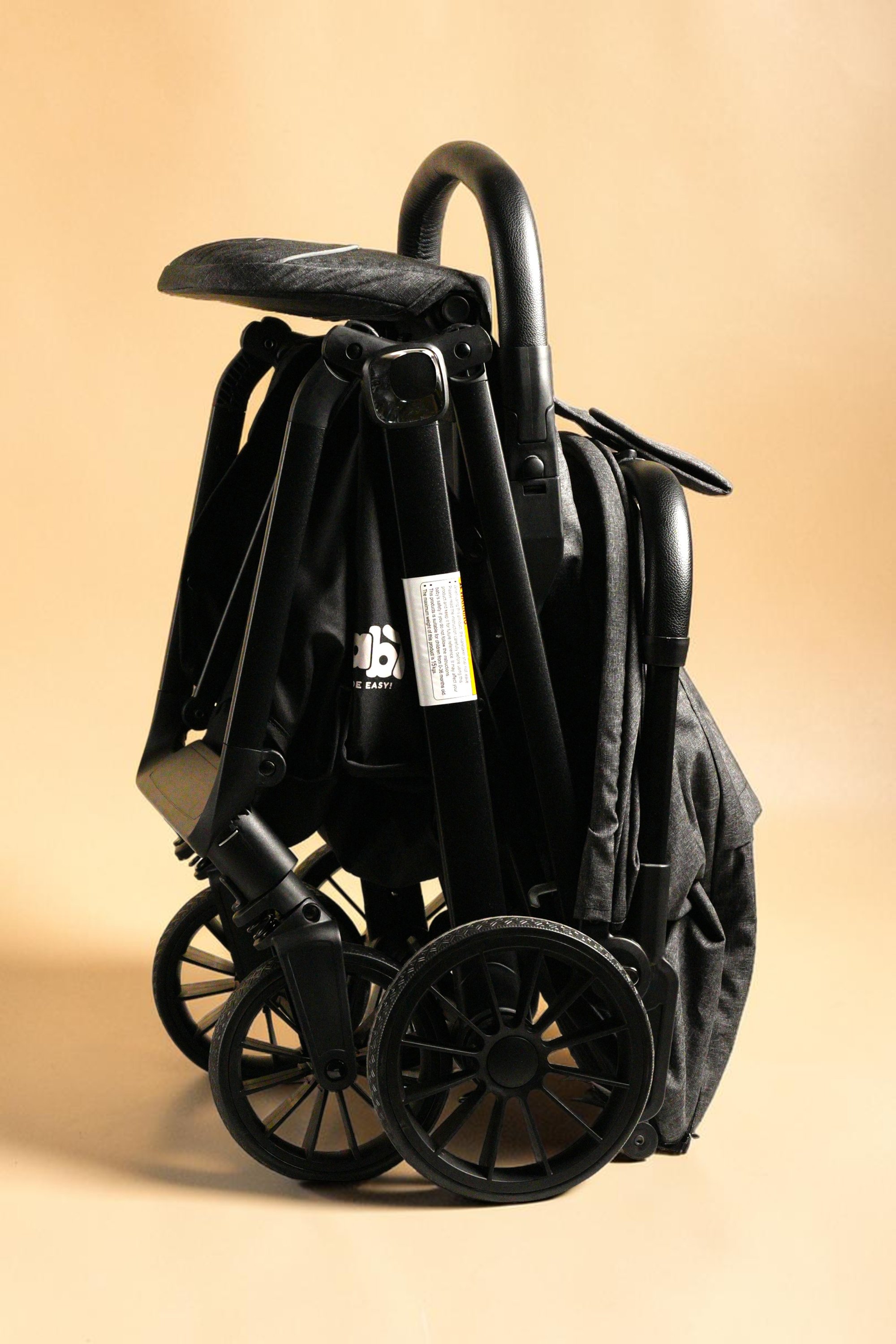
"Stroller", "pram", "pushchair", "buggy", "travel system" — Indian baby-product listings throw all five words around as if they mean the same thing. They don't. Pick the wrong one and you'll either buy something your newborn can't safely use, or something that's obsolete by the time your baby turns six months old. This guide explains exactly what each term means, what age it's for, and which one actually fits Indian parenting in 2026.
A pram is a flat baby carriage for newborns (0–6 months). A pushchair or buggy is an upright seat for toddlers (6+ months). A modern stroller like the Hababy Ultra does both jobs in one frame — flat-recline for newborns, upright for toddlers — which is why it's now the default choice for most Indian parents.
Why the Words Actually Matter
Walk through any Indian baby store and you'll hear "pram" used for everything that has wheels. Online, the words "stroller" and "pushchair" get used as synonyms in the same product listing. This isn't pedantry — the difference decides whether your baby is safe in the seat. A newborn put into a pushchair instead of a pram or fully-reclining stroller can't keep their airway open. A toddler put into a pram is bored and frustrated within a week. The vocabulary used to be correct in your grandmother's generation, and it's worth getting it correct today, because it maps directly onto what age the product is safe for.
What is a Pram?
A pram (short for "perambulator") is the original baby carriage. The baby lies completely flat in a bassinet or carrycot mounted on a wheeled chassis. There is no upright seat option. Prams are designed exclusively for newborns, from birth up to roughly six months — the period when the baby's neck and spine are not yet strong enough for sitting up.
Defining characteristics of a true pram:
- Flat-only sleeping position. No incline, no upright seat.
- Large wheels and high frame. Designed for smooth gliding on pavements, not folding into autos.
- Bulky, heavy, and rarely fold-friendly. Indian apartment lifts and Mumbai locals are not pram-friendly.
- Ages out at six months. Once the baby can sit up, the pram is unusable.
You'll still see traditional prams sold in India, mainly because grandparents associate them with "the proper" way to wheel a newborn. But for most modern Indian families, a pram becomes furniture in the living room within six months.
What is a Pushchair? And What's a Buggy?
A pushchair is essentially a wheeled chair for an older baby or toddler. The seat is upright (or semi-reclined at most), and the child faces forward to see the world. Pushchairs are intended for babies who can already hold their head up and sit independently — usually from around six months onward, sometimes from four months for a semi-recline pushchair.
A buggy is the British informal word for a lightweight, compact pushchair — usually with an umbrella fold and small wheels. In Indian usage, "buggy" and "pushchair" have effectively merged. If a product calls itself a "lightweight buggy", it means a small, compact upright pushchair for older babies.
- Upright or partial-recline only. Not safe for newborns.
- From 6 months to about 3 years. Some pushchairs go up to 15 kg, others to 22 kg.
- Lighter and more compact than prams. Easier to fold, easier in autos and trains.
- Cheaper than full strollers. Usually under ₹5,000.
The catch: if you buy a pushchair as your first product, you can't use it for the first six months. You'll need a separate carrycot, a baby carrier, or a borrowed pram to bridge the gap.
What is a Stroller?
A stroller — in the modern Indian and international sense — is a single chassis that does both jobs. The seat reclines completely flat for newborn use (replacing the pram), and sits fully upright for older babies and toddlers (replacing the pushchair). One product, birth to three years.
This is what most parents in India and globally now buy as their primary wheeled product. It's why the word "stroller" has effectively replaced "pram" and "pushchair" in modern catalogues.
What makes a stroller a stroller, not just a fancy pushchair:
- True flat recline. The seat must lie at 175–180°, not 150°. This is the safety-critical detail for newborns.
- 5-point harness. Two shoulder, two waist, one between the legs — the international safety standard.
- EN1888 or equivalent certification. The European standard covers stability, brakes, harness, and frame strength.
- One-handed fold. You will be holding the baby with the other hand. Always.
- Wheels rated for uneven ground. Indian footpaths are not Berlin pavements.
The Hababy Ultra is a modern stroller in this exact sense: 175° flat recline for newborns, upright for toddlers, EN1888 European safety certified, one-handed fold, and India-tuned wheels with all-round suspension. ₹7,999 with free shipping and a 7-day return.
What is a Travel System?
A travel system is a stroller chassis that accepts three different attachments: a regular toddler seat, a flat carrycot for newborns, and a clip-in infant car seat. The idea is to move the baby from car to chassis without unbuckling.
Travel systems are popular in the US, the UK and Australia, where infant car seats are mandatory by law. In India:
- Infant car seats are not legally required for taxis or autos, and most family cars are not used for daily school runs the way they are in the West.
- Travel systems are 2–3× the price of an equivalent stroller, because of the extra modules.
- The carrycot module duplicates what a fully-reclining stroller already does.
For most Indian parents, a modern stroller with full recline does what a travel system does, at a fraction of the cost and bulk. A travel system is worth it only if you'll genuinely use the car-seat module daily.
Side-by-Side Comparison
| Feature | Pram | Pushchair / Buggy | Modern Stroller | Travel System |
|---|---|---|---|---|
| Newborn safe (flat recline) | Yes | No | Yes | Yes (carrycot) |
| Toddler safe (upright) | No | Yes | Yes | Yes |
| Age range covered | 0–6 mo | 6 mo–3 yr | 0–3 yr | 0–3 yr |
| Folds for autos / trains | No | Yes | Yes | Bulky |
| Typical price (India) | ₹6–15k | ₹3–6k | ₹7–15k | ₹25–60k |
| One product covers everything | No | No | Yes | Yes |
Which One Actually Fits Indian Parenting?
If you're buying once and want it to last from birth to age three, the answer for almost every Indian family is a modern stroller with true flat recline. Here's why:
1. Indian apartments are small
You don't have room to store both a pram (for the first six months) and a pushchair (for after). A single stroller occupies one corner.
2. Autos, trains, and lifts
A pram doesn't fit in an auto. A travel system barely folds. A modern stroller is designed to compress — the Hababy Ultra folds to 24×46×76 cm, fits in an auto boot, and goes vertically into a Mumbai local lift.
3. Indian summers and napping
Babies in India nap on the move — in markets, at the temple, on evening walks. Full flat-recline matters even after six months, because babies still need flat sleep until much later.
4. Family use across multiple caregivers
One stroller used by parents, grandparents, and a nanny is more practical than separate prams and pushchairs that not everyone knows how to operate.
5. Resale value
A high-quality modern stroller holds resale value across the full three years. A pram that's unused after six months and a pushchair bought as a separate second product both depreciate hard.
If you drive your own car daily and want infant car-seat integration, a travel system is justified. For everyone else — especially apartment dwellers, frequent flyers, and grandparent-supported families — a modern stroller wins.
Frequently Asked Questions
What is the difference between a stroller, a pram, and a pushchair?
A pram is a flat-lying baby carriage for newborns up to about six months. A pushchair (or buggy) is an upright seat for toddlers from roughly six months onward. A stroller is the modern all-in-one: a single frame that fully reclines for newborns and sits upright for toddlers, replacing both.
Is a pram or stroller better for a newborn in India?
For a newborn you need a flat recline. Either a traditional pram or a modern fully-reclining stroller works. Most Indian parents now choose a stroller because it adapts as the child grows; a pram becomes unusable after six months.
Can I use a pushchair for a newborn?
No. A traditional pushchair has only a partially reclined seat. Newborns can't support their head or airway in a semi-upright position. Use a pram or a fully-reclining stroller until at least six months.
What is a buggy? Is it different from a pushchair?
Buggy is a British informal word for a lightweight pushchair — compact, umbrella-fold, designed for older babies and toddlers. In India, buggy and pushchair are used interchangeably.
What is a travel system stroller?
A travel system is a stroller frame that accepts a separate infant car seat and a separate carrycot, all on the same chassis. Expensive and bulky, and most Indian parents don't need it.
Which is best for Indian roads — a pram, pushchair, or stroller?
A modern stroller wins for Indian conditions. It folds for autos and trains, has wheels rated for uneven footpaths, reclines flat for napping in summer heat, and works from birth to toddler age. Look for EN1888 certification, all-wheel suspension, and a one-handed fold.
What age is each type of baby carriage for?
Pram: 0–6 months (flat lying only). Pushchair / buggy: 6 months to 3+ years (sitting upright). Stroller (modern fully-reclining): 0 months to 3+ years (covers both stages). Travel system: 0–3 years with separate car seat and carrycot pieces.